
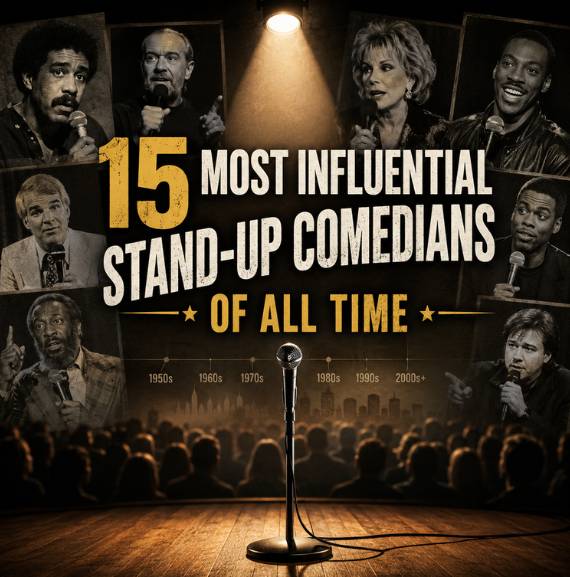
15 Most Influential Stand-Up Comedians of All Time
Being one of the greatest comedians is one thing. Changing what stand-up comedy can be is another.
The most influential stand-up comedians did more than make audiences laugh. They changed how comedians write, perform, talk about politics and identity, use storytelling, challenge social boundaries, and even think about what belongs on a comedy stage.
Some pioneered entirely new approaches to stand-up. Others broke barriers that made new careers possible. A few became so influential that traces of their style can still be heard in comedy clubs decades later.
So who changed stand-up comedy the most? Here is Comedyville’s ranking of the 15 most influential stand-up comedians of all time.
How We Ranked the Most Influential Stand-Up Comedians
This is not a ranking of the funniest comedians or necessarily the greatest overall stand-up careers. For that, see our separate guides to the funniest stand-up comedians of all time and the greatest stand-up comedians of all time.
For this ranking, influence means changing what came afterward. We considered:
- Innovation: Did they introduce or popularize a new approach to stand-up?
- Influence on other comedians: Can their impact be seen in later generations?
- Cultural impact: Did their comedy change conversations beyond comedy clubs?
- Breaking barriers: Did they open opportunities or expand what comedians could say or do?
- Lasting impact: Does their influence remain visible in stand-up today?
This makes influence different from popularity, ticket sales, awards, fame or simply being funny.
1. Richard Pryor
What he changed: Personal storytelling and radical honesty in stand-up.
Richard Pryor transformed personal experience into something much larger. Race, relationships, addiction, violence, fear and his own failures became material for deeply human stories rather than simply setups for punchlines.
His willingness to expose himself onstage helped establish a model of autobiographical stand-up that remains central to modern comedy. Pryor could inhabit characters, switch perspectives and turn painful experiences into performances that were simultaneously hilarious and vulnerable.
Where his influence remains: Storytelling, confessional comedy, character work and deeply personal stand-up.
Essential watch: Richard Pryor: Live in Concert (1979) and Live on the Sunset Strip (1982).
2. Lenny Bruce
What he changed: What comedians were willing to say onstage.
Lenny Bruce helped turn stand-up into a vehicle for challenging religion, politics, sexuality, censorship and social hypocrisy. His battles over obscenity became inseparable from his legacy and helped establish the comedian as someone who could confront cultural boundaries rather than simply entertain within them.
Bruce’s influence extends far beyond comedians who sound like him. Every comic who treats the stage as a place to question what society considers acceptable owes something to the path he helped create.
Where his influence remains: Provocative comedy, political stand-up, social criticism and debates about free expression.
Essential watch/listen: The Carnegie Hall Concert and the documentary Lenny Bruce: Swear to Tell the Truth.
3. George Carlin
What he changed: Language, social criticism and the intellectual possibilities of stand-up.
George Carlin evolved from a conventional television-friendly comic into one of stand-up’s most uncompromising observers of language, politics, religion and American culture.
His famous routine about words that could not be said on television became part of a landmark American broadcasting case, but Carlin’s larger influence came from demonstrating how carefully constructed stand-up could dissect language itself.
Generations of comedians inherited his belief that stand-up could be funny while aggressively questioning the assumptions audiences bring into the room.
Where his influence remains: Political comedy, linguistic comedy, social commentary and long-form stand-up arguments.
Essential watch: Jammin’ in New York (1992).
4. Mort Sahl
What he changed: Modern political stand-up.
Mort Sahl helped create the image of the comedian as a contemporary political commentator. Armed famously with a newspaper rather than a traditional collection of setup-and-punchline jokes, Sahl talked directly about politicians, current events and American institutions.
That approach was radical in the 1950s. His conversational, topical style helped establish a path later followed by political satirists and socially engaged stand-ups across generations.
Where his influence remains: Topical comedy, political satire, conversational stand-up and current-events comedy.
Essential watch/listen: Sahl’s early live recordings and television appearances from the late 1950s and early 1960s.
5. Joan Rivers
What she changed: The possibilities for women in mainstream stand-up.
Joan Rivers developed an aggressive, brutally self-deprecating style in a comedy business overwhelmingly dominated by men. She talked openly about appearance, relationships, sex, ageing and insecurity while refusing the expectation that female comedians needed to be restrained or agreeable.
Her influence goes beyond her joke style. Rivers broke major barriers in American late-night television and demonstrated that a female stand-up could build a long career around an uncompromising comic persona.
Where her influence remains: Self-deprecating comedy, insult comedy, confessional humour and generations of female stand-ups who followed her.
Essential watch: Joan Rivers: A Piece of Work (2010).
6. Dick Gregory
What he changed: Race, politics and activism in mainstream stand-up.
Dick Gregory emerged during the civil-rights era and used comedy to confront racism directly in rooms where Black comedians had historically faced enormous barriers.
His career demonstrated that political activism and stand-up did not need to exist separately. Gregory could make audiences laugh while forcing them to confront racial inequality, and his public activism eventually became as central to his identity as his comedy.
Where his influence remains: Political stand-up, racial commentary, activist comedy and socially conscious humour.
7. Eddie Murphy
What he changed: The scale and star power of stand-up comedy.
Eddie Murphy became a stand-up superstar while still extraordinarily young. His charisma, character work, impressions and physical confidence gave his performances the energy of a rock concert.
Delirious and Raw helped establish a model of the stand-up special as a major entertainment event rather than simply a recording of a club performance. His crossover success also demonstrated how stand-up could launch a performer into the highest levels of popular culture.
Where his influence remains: High-energy performance, character comedy, arena stand-up and the comedian as global entertainment star.
Essential watch: Delirious (1983) and Raw (1987).
8. Steve Martin
What he changed: Absurdist stand-up and the rejection of traditional punchlines.
Steve Martin became one of the biggest comedy stars of the 1970s by deliberately playing with the mechanics of comedy itself. His act could be ridiculous, self-aware and intentionally disconnected from conventional setup-and-punchline structure.
Martin showed that audiences could laugh at the performance of comedy, not merely at individual jokes. His influence can be seen throughout absurdist, alternative and anti-comedy traditions that followed.
Where his influence remains: Absurdist comedy, anti-comedy, conceptual stand-up and deliberately unconventional performance.
9. Dave Chappelle
What he changed: The modern long-form stand-up conversation.
Dave Chappelle combines storytelling, social commentary, race, celebrity, politics and philosophical observation in performances that can feel as much like extended conversations as conventional stand-up routines.
His enormous cultural reach has reinforced the idea that a stand-up special can become a major public conversation. His influence is especially visible in comedians who use long stories, deliberate pacing and social analysis rather than chasing a punchline every few seconds.
Where his influence remains: Long-form storytelling, social commentary, conversational pacing and modern prestige stand-up specials.
Essential watch: Killin’ Them Softly (2000).
10. Chris Rock
What he changed: The architecture of modern social-commentary stand-up.
Chris Rock’s tightly written arguments, repetition, physical delivery and willingness to tackle race, class, relationships and politics created one of the most recognizable stand-up styles of the 1990s.
Bring the Pain became a defining performance of its era. Rock demonstrated how a comedian could take a complicated social observation, reduce it to a powerful premise and repeatedly attack it from different angles.
Where his influence remains: Social commentary, premise-driven stand-up, rhetorical repetition and high-energy political comedy.
Essential watch: Bring the Pain (1996).
11. Redd Foxx
What he changed: Adult comedy recordings and the path toward more uncensored Black stand-up.
Long before comedy specials became ubiquitous, Redd Foxx built an enormous following through adult-oriented comedy records. His performances helped establish an audience for material that mainstream television and radio would not accommodate.
Foxx’s success demonstrated that comedians could reach audiences outside traditional broadcast gatekeepers, while his unapologetic style helped expand the possibilities available to later Black stand-ups.
Where his influence remains: Adult stand-up, comedy albums, uncensored performance and Black comedy traditions.
12. Phyllis Diller
What she changed: The female stand-up persona.
Phyllis Diller built a deliberately exaggerated stage character around outrageous appearance, rapid-fire jokes and relentless self-deprecation. At a time when relatively few women were able to build major careers as solo stand-ups, Diller became nationally recognizable.
Her success helped expand the space available to female comedians and proved that a woman could command a stage through an eccentric comic persona entirely her own.
Where her influence remains: Character-driven stand-up, self-deprecation and the history of women in comedy.
13. Robin Williams
What he changed: Improvisational energy and physical performance in stand-up.
Robin Williams made stand-up feel almost limitless. Characters, voices, impressions, physical movement and spontaneous riffs could arrive one after another at extraordinary speed.
His performances expanded expectations of what a solo comedian could physically do onstage and helped popularize an intensely improvisational approach to stand-up.
Where his influence remains: Improvisation, character work, physical comedy and high-speed performance.
Essential watch: An Evening at the Met (1986).
14. Jerry Seinfeld
What he changed: The modern observational-comedy model.
Jerry Seinfeld did not invent observational comedy, but his enormous success helped make meticulous comedy about ordinary behaviour one of the dominant styles of modern stand-up.
Rather than relying primarily on confession, politics or shock, Seinfeld built jokes by examining everyday rituals and asking why people behave the way they do. His precision helped establish observational joke-writing as a model generations of club comedians could study and emulate.
Where his influence remains: Observational comedy, clean stand-up and tightly engineered joke writing.
15. Bill Hicks
What he changed: Confrontational philosophical and political stand-up.
Bill Hicks treated the stage as somewhere to attack consumerism, politics, religion, advertising and cultural complacency. His intensity and willingness to move between jokes and extended arguments gave his work a distinctive confrontational quality.
His career was relatively short, but his reputation grew considerably after his death, particularly among comedians attracted to stand-up as a vehicle for political and philosophical criticism.
Where his influence remains: Political comedy, countercultural stand-up and confrontational social commentary.
Essential watch: Revelations (1993).
Influential Comedians Who Just Missed the Top 15
Any ranking of comedy influence is debatable. Several other comedians have strong cases, including Moms Mabley, Jonathan Winters, Don Rickles, Bob Newhart, Norm Macdonald, Hannah Gadsby and Ali Wong.
Their absence from the Top 15 does not mean their work was unimportant. It reflects how difficult it is to compare different kinds of influence across more than a century of comedy.
Greatest vs. Funniest vs. Most Influential Comedians
These terms describe different things.
A comedian can be one of the greatest because of an extraordinary overall body of work. Another might rank among the funniest because of pure laugh-generating ability. An influential comedian changes what other performers can do or how audiences understand stand-up itself.
That’s why the rankings on Comedyville are deliberately different. Richard Pryor scores extraordinarily well across all three categories, while pioneers such as Mort Sahl and Dick Gregory rank particularly high here because their importance to the development of stand-up extends beyond their fame with today’s audiences.
Frequently Asked Questions
Who is the most influential stand-up comedian of all time?
Comedyville ranks Richard Pryor as the most influential stand-up comedian of all time. His combination of autobiographical storytelling, vulnerability, character work and commentary on race helped shape generations of comedians who followed him.
How did Lenny Bruce influence stand-up comedy?
Lenny Bruce pushed against restrictions surrounding language, religion, politics and sexuality. His obscenity prosecutions became part of the broader history of free expression in American comedy, and his confrontational approach helped create space for later countercultural comedians.
How did George Carlin change stand-up comedy?
George Carlin transformed himself from a conventional entertainer into a comedian known for examining language, politics, religion and social behaviour. His work demonstrated how stand-up could combine carefully constructed writing with sustained cultural criticism.
Who helped pioneer modern political stand-up?
Mort Sahl was one of the central pioneers of modern political stand-up. His topical, conversational performances in the 1950s helped move comedy away from collections of conventional jokes and toward direct commentary on politicians and current events.
Who were some of the most influential women in stand-up comedy?
Joan Rivers and Phyllis Diller were major pioneers who built successful stand-up careers when the industry offered women far fewer opportunities. Earlier performers such as Moms Mabley were also crucial to the history of women in American comedy.
What makes a comedian influential?
Influence is about what changes after a comedian’s work becomes known. That can mean inspiring later performers, introducing a new style, breaking cultural or industry barriers, changing what audiences accept onstage, or expanding what stand-up comedy can accomplish.
Final Thoughts
The history of stand-up comedy is not simply a history of who got the biggest laughs. It is also the story of performers who changed the rules for everyone who followed.
From Lenny Bruce challenging boundaries and Mort Sahl transforming political satire to Richard Pryor revolutionizing personal storytelling, Joan Rivers breaking barriers and George Carlin turning language itself into material, each comedian on this list left something behind that became part of modern stand-up.
And that process continues. Every generation produces comedians who borrow from what came before, reshape it and eventually influence someone else.
If you’re interested in how comedy is built at the joke level, read our guide on how to write a comedy joke that works. If you’re thinking about stepping onstage yourself, see how to perform at a comedy show for the first time.
And if you’d rather experience stand-up live, see the latest Comedyville shows in downtown Montreal.
Post by Eddie Case, exclusively for Comedyville.ca, All rights reserved.
Comedyville is a Comedy Club located in Downtown Montreal.
 Previous Post
 Next Post